
Table of Contents
- Can You Use Foot Comfort Spray on Stockings? The Short Answer
- Spray Feet Before or After Putting on Stockings? The Right Order
- How to Apply Foot Comfort Spray for a Clean, Even Finish
- Choosing a Foot Spray That Won't Stain Hosiery
- How to Wear Heels with Stockings Comfortably All Day
- Lidocaine Spray for Foot Pain in Heels: What to Know Before You Spray
- Common Mistakes to Avoid When Spraying Stockings and Feet
- Conclusion
- Frequently Asked Questions
Last Updated: October 17, 2026
Can You Use Foot Comfort Spray on Stockings? The Short Answer
Yes, you can use foot comfort spray on stockings, but only if you apply it correctly and test the fabric first.
Foot comfort spray is a topical product that reduces friction and pressure on the skin. Stockings sit between your skin and the spray, affecting absorption, drying time, and how it feels on your toes and the ball of your foot.
Spray Feet Before or After Putting on Stockings? The Right Order
Spray your bare feet first, let them dry fully, then roll on your stockings. This order gives the product direct contact with your skin and avoids wet residue on delicate fabric. The over-hosiery method works too, but only as a light touch-up.
The Bare-Foot Method: Spray, Dry, Then Roll
This is the method we recommend for most people. It takes about a minute.
- Wash and dry your feet completely.
- Hold the bottle 6 to 8 inches from your skin.
- Spray lightly over the ball of the foot, toes, and heel.
- Wait 5 to 10 seconds for the product to dry.
- Roll on your stockings slowly, without pulling hard.
The wait matters: pulling on sheer nylons while your feet are wet makes the fabric snag.
The Over-Hosiery Method: When and How to Spray on Fabric
Spraying directly on stockings is fine for a quick refresh, but keep it light: hold the bottle 10 to 12 inches away, use short bursts, and one pass is enough. Skip this on expensive or delicate hosiery, sheer fabric shows every mark, and a heavy spray can leave a greasy patch. For a formal party or long wedding day, use the bare-foot method instead.
How to Apply Foot Comfort Spray for a Clean, Even Finish
A clean, even finish comes down to distance, quantity, and drying time. Most mistakes happen when people spray too close or too much.
- Shake the bottle well before each use.
- Spray from 6 to 8 inches away on bare skin.
- Use one light pass per foot, not three.
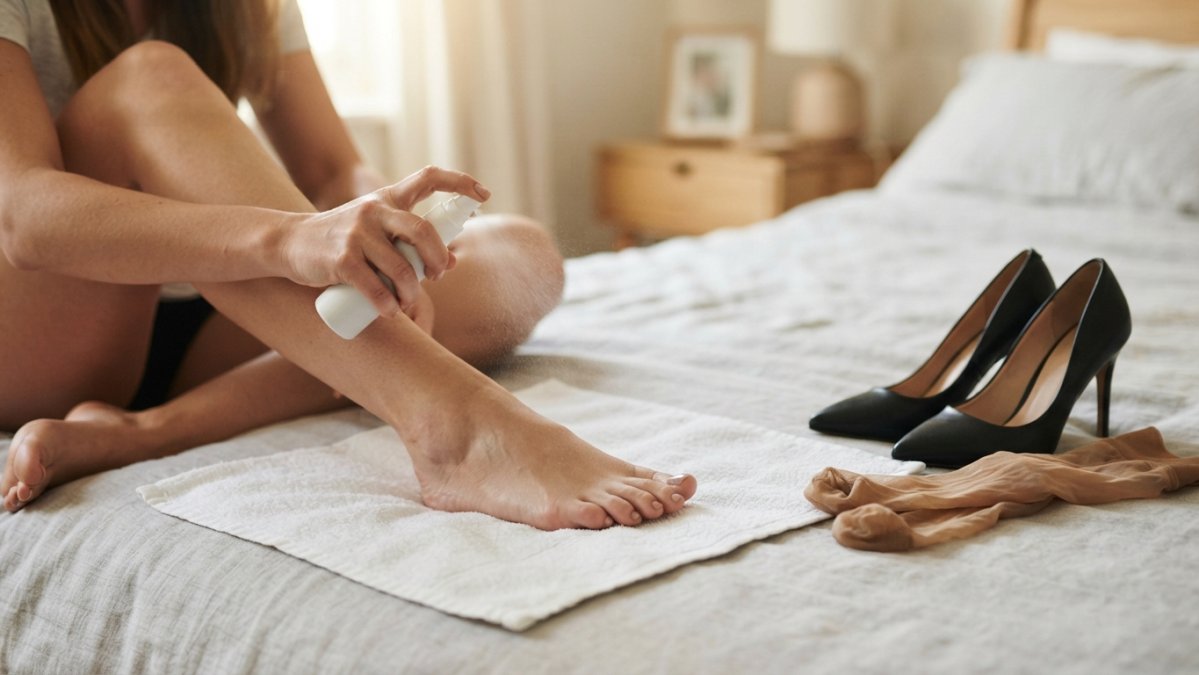
Before a long event, apply 10 to 15 minutes before putting on your shoes so the product settles and your pumps do not slide around.
Choosing a Foot Spray That Won't Stain Hosiery
A foot spray that won't stain hosiery will be light, fast-drying, and free of heavy oils, but "won't stain" is a claim you must verify against your specific pair. The same spray that disappears into an opaque tight can leave a visible ring on 15-denier sheer nylon. Read the label and, when in doubt, contact the manufacturer.
Why Hosiery Fabric Changes the Equation
Hosiery is not one material. Most pairs are knit from nylon blended with spandex, and the knit density, measured in denier, determines how much a liquid sits on the surface versus wicks into the yarn.
- Sheer nylon (roughly 10-20 denier): the thinnest, most transparent knit. Any oil, tint, or thick residue shows through immediately, and a wet patch can dry into a stiff, shiny spot.
- Semi-opaque (roughly 30-40 denier): more forgiving of a light mist, but heavy product can still darken the knit and leave a tacky feel against the shoe.
- Opaque tights and control-top styles (50 denier and up): denser yarn hides minor residue, but the tighter weave holds moisture longer, so drying time matters more than ever.
A clear, fast-drying spray is the safest bet across all four. Tinted, creamy, or oil-heavy formulas are most likely to transfer color or leave a greasy patch under a closed shoe.
Read the Label Like an Editor
What to look for on the back of the bottle before you buy:
- Drying claim: "dries in seconds" beats "dries to a powder" for hosiery, because powders can pill against nylon.
- Oil and emollient words: "balm," "butter," "heavy cream," "petrolatum," and "mineral oil" signal a formula that can mark sheer fabric.
- Tint and fragrance: dyes and some fragrances can transfer to light nylons; a clear, lightly scented or unscented formula is lower risk.
We built Still Standing® Spray as a non-numbing, fast-drying formula with no greasy film. That is a product-specific claim, always confirm against the label of whatever bottle you are holding.
Fabric Patch Test: A Two-Minute Check Before the Event
Test any spray on your hosiery before the big day, two minutes saves a ruined pair of nylons.
- Turn the stocking inside out so you test the surface that will touch your skin.
- Spray a small amount on the inner ankle area, a spot hidden by the shoe line.
- Wait at least five minutes, longer if the label lists a longer dry time.
- Check for a wet mark, color change, stiff patch, or tacky feel.
- If the fabric looks and feels the same, you are clear to use it on that pair.
Do this at least a day before the event: some finishes and dyes react slowly, and you want time to switch pairs. Test each distinct pair and color, a pass on black opaque tights does not clear nude sheer nylons.
If a Spray Does Leave a Mark
Act while the fabric is still damp. Blot, do not rub, with a clean, dry cloth to lift surface product, then let the stocking air-dry flat; rubbing pushes residue deeper into the knit. If a mark remains, switch to a tested pair and check the hosiery's care instructions or the manufacturer's customer service line for stain removal.
How to Wear Heels with Stockings Comfortably All Day
Wearing heels with stockings comfortably all day comes down to fit, friction control, and a few backup tools. Stockings change how your foot sits inside the shoe: the fabric slides, your foot moves more, and that movement creates hot spots.
Try these habits:
- Choose heels with a roomy toe box so your toes are not pinched.
- Add a thin shoe insert or foot cushion at the ball of the foot.
- Keep moleskin in your bag for hot spots that appear mid-day.
A common mistake is buying heels a half size too small because they felt snug with bare feet. With stockings, that snug fit becomes a pinch. Try shoes on with the hosiery you plan to wear.
Lidocaine Spray for Foot Pain in Heels: What to Know Before You Spray
Lidocaine spray for foot pain in heels is an over-the-counter numbing product that works differently from a comfort spray. Lidocaine is a local anesthetic: it dulls feeling in the skin, which can ease pain but raises real risks in stilettos, risks that multiply when applied over or under hosiery.
Comfort Spray vs. Numbing Spray: An Ingredient-Level Difference
"Foot comfort spray" is not a regulated category. Two bottles on the same shelf can contain very different things:
- Comfort and friction formulas typically rely on lubricants, silicones, or light powders to reduce rubbing and pressure. They are not intended to change sensation.
- Numbing formulas contain an anesthetic, lidocaine, benzocaine, pramoxine, or a related ingredient, and are intended to dull pain signals. These carry drug-facts labeling with warnings, maximum daily applications, and age restrictions.
- Combination products may pair an anesthetic with a moisturizer or deodorant, which complicates both the fabric question and the reapplication limits.
Read the drug facts panel, not the front label: the active ingredient, "do not use" list, and "when using this product" warnings tell you what you are actually putting on your skin.
The Balance Problem With Numb Feet
Your feet provide constant sensory feedback, pressure shifts, uneven ground, the edge of a stair, that helps you stay upright.
Other points to know:
- Follow the product instructions exactly on how often to reapply, and never exceed the stated maximum.
- Do not use an anesthetic spray on broken skin, cuts, or open blisters.
- Do not combine it with other numbing products, including patches or creams, without checking with a pharmacist or doctor.
This is why we chose a non-numbing formula for Still Standing® Spray. Our goal is to prevent pain from friction and pressure, not to mask it by dulling nerves. You keep full feeling in your feet and stay steady on your heels.
If You Feel Numbness, Stinging, or Irritation
Stop using the product at the first sign of trouble. Numbness that outlasts the expected wear-off time, stinging, burning, redness, or a rash are all reasons to act rather than push through an event.
- Remove the shoes and hosiery.
- Wash the area with mild soap and cool water, do not scrub.
- Pat dry and let the skin rest without product for the rest of the day.
- Do not reapply the spray, and do not cover the area with a numbing patch.
- If symptoms are severe, spreading, or do not settle, contact a doctor or a poison control center. For product-specific questions, the manufacturer's label and customer service line are the first stop.
For general skin-reaction guidance, the American Academy of Dermatology offers plain-language advice on product reactions. If you are unsure whether a symptom is a normal reaction or something more, err on the side of calling a clinician, especially before your next event.
A Safer Sequence If You Choose a Numbing Product Anyway
Some readers will still reach for an anesthetic spray. If so, the lowest-risk sequence is: apply to clean, dry, intact bare skin only, never directly onto hosiery, where the fabric can hold product against the skin longer than intended, let it dry fully per the label, keep the application light, and skip heels on stairs or uneven ground for the rest of the day.
Common Mistakes to Avoid When Spraying Stockings and Feet
Most problems with foot spray and hosiery come from a few avoidable mistakes:
- Spraying too close. This soaks the fabric and leaves a wet patch.
- Skipping the dry time. Wet feet grab nylons and cause snags.
- Not patch testing. A stained pair of stockings cannot be fixed.
If irritation or numbness happens, stop using the product. Wash the area with mild soap and water, let your skin rest, and skip heels for the day. For general skin safety guidance, the American Academy of Dermatology offers plain-language advice on product reactions.
For most people, a light hand and a patch test solve the whole problem. The goal is a thin, even layer that dries fast, not a heavy coat.
Conclusion
Getting through a long event in heels takes planning, and hosiery adds a step most people forget. Spray your bare feet, let them dry, test your stockings first, and keep the application light.
Still Standing® Spray was made for exactly this. Our non-numbing formula prevents foot pain without the dangerous falls that come with numbing products.
Get started with Still Standing® Spray and wear your heels with confidence from the first dance to the last.
Frequently Asked Questions
Can you use foot comfort spray on stockings?
Yes, but how you apply it matters. The safest approach is to spray a foot comfort spray on bare feet, let it dry fully for about 5 to 10 seconds, and then roll on your stockings. Spraying directly onto hosiery works for some products, but you should patch test first because fabric fibers, especially nylon and sheer pantyhose, can hold residue or show marks. Always check the product label for fabric guidance before spraying over stockings you plan to wear to a wedding or formal event.
Should you spray your feet before or after putting on stockings?
Spray before putting on stockings whenever possible. Apply a light, even layer to clean, dry bare feet, wait 5 to 10 seconds for it to dry fully, then roll the hosiery on gently. This order keeps the product on skin rather than fabric and reduces the chance of residue, greasy patches, or runs in sheer nylons. If you need a touch-up later in the day, spray lightly over the stocking from about six inches away and let it air dry before sliding your heels back on.
Does lidocaine spray help with foot pain in heels?
Lidocaine is an over-the-counter anesthetic that numbs skin, so it can dull pain from pressure and friction in high heels. The trade-off is that numbness can reduce your awareness of the ground, which raises the risk of slips and falls, especially on stairs or dance floors. Many podiatrists caution against masking pain during long events because you may not notice a developing blister or hot spot. A non-numbing foot comfort spray is an alternative for people who want relief without losing sensation.
How do you keep heels comfortable with stockings for a long event?
Start with a foot comfort spray on bare feet, let it dry, then put on stockings. Choose heels with a padded footbed or add a thin shoe insert under the ball of the foot, and break in new shoes for a few days before the event. Bring a wet wipe and a spare pair of flats for later in the night. Rotating pressure by sitting when you can and stretching your toes helps too. Still Standing® Spray reports it works for 94% of users, and it carries a 30-day money-back guarantee if it does not suit you.