
Table of Contents
- Why Office Work Breaks Your Feet (and What Actually Helps)
- How to Stop Feet From Hurting at Work: The Full Comparison
- The Best Work Shoes for Foot Pain: What to Look For
- Insoles for Foot Pain at Work: Cushioning, Arch Support, and Cost
- Comfort Sprays for Heel Wearers: A Fair Review
- Foot Stretches for Office Workers: A Five-Minute Daily Routine
- Mats, Movement Breaks, and Workplace Accommodations
- When to See a Podiatrist (and What to Try First)
- Frequently Asked Questions
Last Updated: October 19, 2026
Why Office Work Breaks Your Feet (and What Actually Helps)
Office work hurts feet in two opposite ways, and most foot pain solutions ignore the split.
Desk workers who sit for eight hours often stand up to sharp heel pain, because sitting reduces circulation and leaves the plantar fascia tight.
Foot health at work comes down to three levers: what you wear, how you insert cushioning, and how often you move.
How to Stop Feet From Hurting at Work: The Full Comparison
Stopping feet from hurting at work means combining three layers: supportive footwear, cushioning or arch support, and regular movement. No single product fixes a full shift. The comparison below ranks each option by cost, effort, best-fit work setting, and evidence strength.
Comparison Table: Solutions by Cost, Effort, and Best Use
| Solution | Typical Cost | Effort | Best For | Main Limitation | Evidence Quality |
|---|---|---|---|---|---|
| Supportive work shoes | Varies widely | High (shopping, break-in) | Standing shifts, hard floors | Needs correct fit to work | Strong expert consensus; fit is the active ingredient |
| Cushioned insoles | Low to moderate | Low | General soreness, cushioning | Wears out, can crowd toe box | Moderate; short-term comfort gains are consistent |
| Orthotic inserts | Moderate to high | Medium | Arch support, heel pain | Needs proper fitting | Moderate for arch and heel symptoms; mixed for prevention |
| Comfort spray | Low | Very low | Heels, dress shoes, events | Not a structural fix | Anecdotal and comfort-focused; not a mechanical treatment |
| Anti-fatigue mats | Moderate | Low | Standing desks, counters | Doesn't travel with you | Moderate for standing fatigue; strongest when paired with movement |
| Stretching routine | Free | Low (5 min daily) | Stiffness, plantar fasciitis | Needs consistency | Good for plantar fascia and calf tightness when done daily |
| Movement breaks | Free | Low | All-day circulation | Requires habit and reminders | Strong for circulation and stiffness; low cost, low risk |
The table shows why "one product" advice fails. A standing worker on concrete needs shoes and a mat; a desk worker with morning heel pain needs stretching and movement breaks more than cushioning. Shoes, stretching, and movement have the most consistent support; sprays and mats are comfort tools.

Match the Solution to Your Work Setting
Start with how your day is structured, not with a product category.
Desk-heavy days (six or more hours seated). The main problem is stiffness and reduced circulation, not impact load.
Standing-heavy shifts (retail, clinical, hospitality, front desk). Impact and arch load dominate.
Mixed-shift roles (standing desk, warehouse-to-office, hybrid schedules). You need portability.
Dress-code-constrained roles (heels, pumps, hard dress shoes). Insoles often will not fit and mats are not an option.
A Practical Trial Method for Any Solution
Test each option like a small experiment.
- Set a two-week trial window. Most comfort changes show a signal within that period; structural changes like shoes may need three to four weeks of break-in.
- Track one symptom, not five. Pick the single complaint that bothers you most (morning heel pain, mid-afternoon arch fatigue, toe soreness) and rate it 1 to 10 at the same time each day.
- Change one variable at a time. If you add insoles and a mat in the same week, you will not know which one helped.
- Use a keep-or-change rule. If the rating has not improved by at least two points after two weeks, return or replace the item. If it improved, keep it and move to the next layer.
- Re-check fit before you blame the product. Toe crowding and heel slip cause pain that looks like a product failure but is really a sizing problem.
This method also protects your budget: it gives you a defensible reason to return an item and stops you stacking purchases that mask each other's effects.
When the Problem Is More Than Comfort
Self-care has a ceiling. See a podiatrist or other qualified clinician when pain persists beyond a few weeks, wakes you at night, or comes with swelling, numbness, redness, or a change in how you walk. Sharp first-step heel pain that improves with movement often fits plantar fasciitis, which responds well to early treatment. Sudden pain after an injury, warmth and redness, or spreading numbness should be checked promptly.
The Best Work Shoes for Foot Pain: What to Look For
The best work shoes for foot pain share four traits: a wide toe box, a firm heel counter, moderate arch support, and a sole that doesn't flex in the middle.
Supportive footwear does most of the work before any insert enters the picture. Look for:
- Wide, rounded toe box so toes can spread when you stand
- Firm heel counter that holds the heel in place and limits rolling
- Removable insole so you can swap in cushioning or orthotics
Avoid a narrow toe box on any shoe you wear for eight hours. Toe crowding causes bunions, nerve irritation, and forefoot soreness, and no insole will fix that pain.
Shoe Fit and Toe-Box Checks Before You Buy
Shoe fit is the cheapest fix available and the most often skipped. Run three checks:
- The thumb test. Press your thumb between your longest toe and the shoe's front. You want about a thumb's width of space.
- The toe-spread test. Stand and spread your toes. If they can't move, the toe box is too narrow.
- The heel-slip test. Walk ten steps. Your heel should stay seated without sliding up and down.
Shop late in the day when feet are largest, and measure both feet. Most people have one foot slightly larger, and buying to the smaller one is a reliable route to sore feet.
Insoles for Foot Pain at Work: Cushioning, Arch Support, and Cost
Insoles for foot pain at work fall into three tiers: cushioned insoles, orthotic inserts, and custom insoles.
Cushioned insoles add a soft layer under the foot. They help with general soreness and fatigue but don't correct mechanics, and they're cheap and easy to swap between shoes.
Orthotic inserts add arch support and heel cushioning. They suit arch pain and mild heel pain, and many are sold over the counter.
Custom insoles are made to a mold of your foot.
Foot Comfort Spray for Ultimate High Heels →
Match the Insole to Your Pain Location
Where the pain sits should drive the choice more than the price tag.
- Heel pain, especially sharp first steps in the morning. A heel cup or orthotic insert with cushioned heel support is the usual first try. Pair it with the plantar fascia stretch routine; cushioning alone rarely resolves first-step pain.
- Arch pain or fatigue by mid-afternoon. Moderate arch support in an orthotic insert is the better fit than a soft cushion, which can let the arch collapse further.
- Ball-of-foot pain or burning under the toes. Look for a metatarsal pad or a cushioned forefoot, and check that the insole does not push the toes into the shoe's front.
Cost, Durability, and Value Over Time
Insole pricing varies widely, so compare cost per month of use rather than sticker price: a low-cost cushioned insole that compresses in three months can cost more per month than a moderate orthotic insert that lasts a year.
A practical rule: give any insole a two-week trial, track one symptom daily, and return it if the rating has not improved by at least two points.
Comfort Sprays for Heel Wearers: A Fair Review
Comfort sprays don't correct structure, and we won't pretend they do.
Our own Still Standing® Foot Comfort Spray uses a cooling menthol formula made without numbing agents, so you keep natural foot sensation while you walk and stand.
The spray suits heels, pumps, and dress shoes, which is exactly where insoles often won't fit. The mini is TSA-friendly, so it travels in a work bag or carry-on.

Where it falls short: it's a comfort layer, not a cure for plantar fasciitis or a structural foot problem.
American Podiatric Medical Association guidance on foot health
Foot Stretches for Office Workers: A Five-Minute Daily Routine
Foot stretches for office workers take five minutes and target the two structures that complain most: the plantar fascia and the calf. Do this routine morning and mid-afternoon.
- Calf stretch (30 seconds per leg). Hands on a wall, one leg back, heel down. Hold.
- Plantar fascia stretch (30 seconds per foot). Seated, cross one ankle over the knee, pull toes back toward the shin.
- Ankle rotations (10 each direction per foot). Lift one foot and circle slowly.
- Toe spreads and curls (20 seconds). Spread toes wide, then curl them under.
- Towel scrunch (30 seconds per foot). Pull a towel toward you with your toes.
Stretching works best on warm feet, so do it after a walk to the kitchen or a lap around the floor. Consistency beats intensity: five minutes daily outperforms a long session once a week.
Mats, Movement Breaks, and Workplace Accommodations
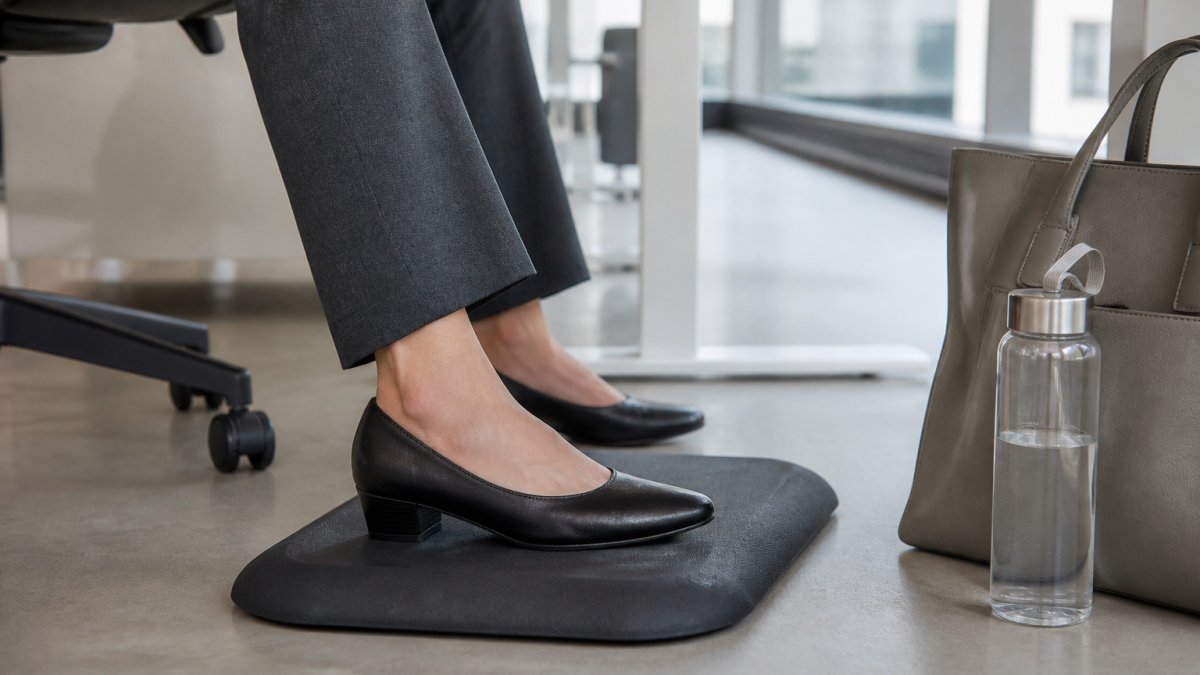
Anti-fatigue mats and movement breaks solve different halves of the same problem. Mats soften the surface under standing workers.
For standing desks and counters, an ergonomic mat with a beveled edge reduces heel and arch load on hard floors.
Workplace accommodations are worth asking about. Many employers will provide a mat, a footrest, or a sit-stand option when you explain the issue.
When to See a Podiatrist (and What to Try First)
Try the low-cost steps first: check shoe fit, add cushioning, start the stretch routine, and take movement breaks.
MedlinePlus overview of heel pain and plantar fasciitis
Red flags that skip the self-care stage: sudden sharp pain after an injury, redness and warmth in the foot, numbness that spreads, or pain that keeps getting worse despite rest.
Office foot pain rarely has one cause, so it rarely has one fix.
Frequently Asked Questions
How do I stop my feet from hurting at work?
Start with the shoe: a supportive work shoe with a roomy toe box and decent arch support removes the most common cause of sore feet. Add cushioned insoles if your shoes are thin-soled, and stand up every 45 to 60 minutes to restore circulation. For heel wearers, a comfort spray applied before putting shoes on can help extend wear time. If pain persists past two weeks despite these changes, get your feet checked by a podiatrist.
What are the best work shoes for foot pain?
Look for a shoe with a firm heel counter, a toe box wide enough to wiggle your toes, and a sole that flexes at the ball of the foot rather than the middle. Low, stable heels (under 2 inches) beat flats for all-day standing because they load the heel less abruptly. Try shoes on late in the day when feet are at their largest, and test them on a hard floor, not carpet.
Can insoles help relieve foot pain at work?
Yes, for many people. Over-the-counter cushioned insoles cost roughly $10 to $30 and help with hard floors and thin-soled shoes. Arch-support inserts run higher and suit people with flat feet or plantar fasciitis symptoms. Custom orthotics are the most expensive option and usually make sense only after a podiatrist assessment. Replace cushioned insoles every three to six months if you stand all day.
How often should I move or stretch during a desk-based workday?
Stand and move at least once every 45 to 60 minutes. A five-minute routine works: 10 ankle rotations per foot, 10 seated calf raises, a standing calf stretch held 20 seconds per leg, and a toe-spread hold. Movement breaks matter more than any single stretch because prolonged sitting is what causes stiffness and swelling in the first place.
When should I see a podiatrist for foot pain?
Book an appointment if pain lasts more than two weeks, wakes you at night, comes with swelling, numbness, or redness, or is concentrated in the heel first thing in the morning (a common plantar fasciitis pattern). Also seek care after any dropped object, sprain, or puncture wound. Early assessment is cheaper than waiting until the pain changes how you walk.