
Last Updated: October 27, 2026
Quick Summary
The signs your high heels are damaging your feet include pain that lasts after you take the shoes off, redness that does not fade, and numbness or tingling in your toes. If any of these show up regularly, your feet are telling you something.
- High heels shift most of your body's weight onto the forefoot, and the higher the heel, the steeper the angle.
- Bunions form when the big toe pushes against the other toes inside a pointed-toe shoe.
- Take heels off as soon as you can and wiggle your toes when numbness strikes.
- Alternate heel heights through the week so no single pair takes all the load.
- Choose inserts with metatarsal support, a slim profile, and material that does not slide.
Table of Contents
- How High Heels Change Your Foot Alignment and Weight Distribution
- 7 Warning Signs Your High Heels Are Damaging Your Feet
- Common High Heel Foot Problems: From Bunions to Ankle Instability
- Toe Numbness After Wearing Heels: What It Means and What to Do
- How to Relieve Foot Pain From High Heels
- Best High Heel Inserts for Ball of Foot Pain: What to Look For
- When to Stop Wearing Heels and When to See a Doctor
- Build a Heel-Wearing Routine That Protects Your Feet
- Frequently Asked Questions
How High Heels Change Your Foot Alignment and Weight Distribution
The signs your high heels are damaging your feet start long before the pain becomes constant. High heels change how your whole body carries weight.
Here is the core problem. A raised heel tips your body forward. To stay balanced, you shift weight onto the ball of your foot and curl your toes for grip. Your ankle joints work harder to keep you steady. Your knees and lower back absorb the extra load.
What the Shift in Pressure Actually Does
Weight distribution is how your body spreads load across your feet when you stand and walk. In flat shoes, that load spreads fairly evenly from heel to toe. In heels, most of it lands on the forefoot.
The higher the heel, the steeper the angle. A steep angle pushes pressure onto a smaller area at the ball of your foot. It also shortens your stride and tightens your calf muscles.
Over time, this altered alignment can affect your knees, hips, and lower back. The American Podiatric Medical Association notes that heel height and wear duration both shape how much strain your feet absorb.
7 Warning Signs Your High Heels Are Damaging Your Feet
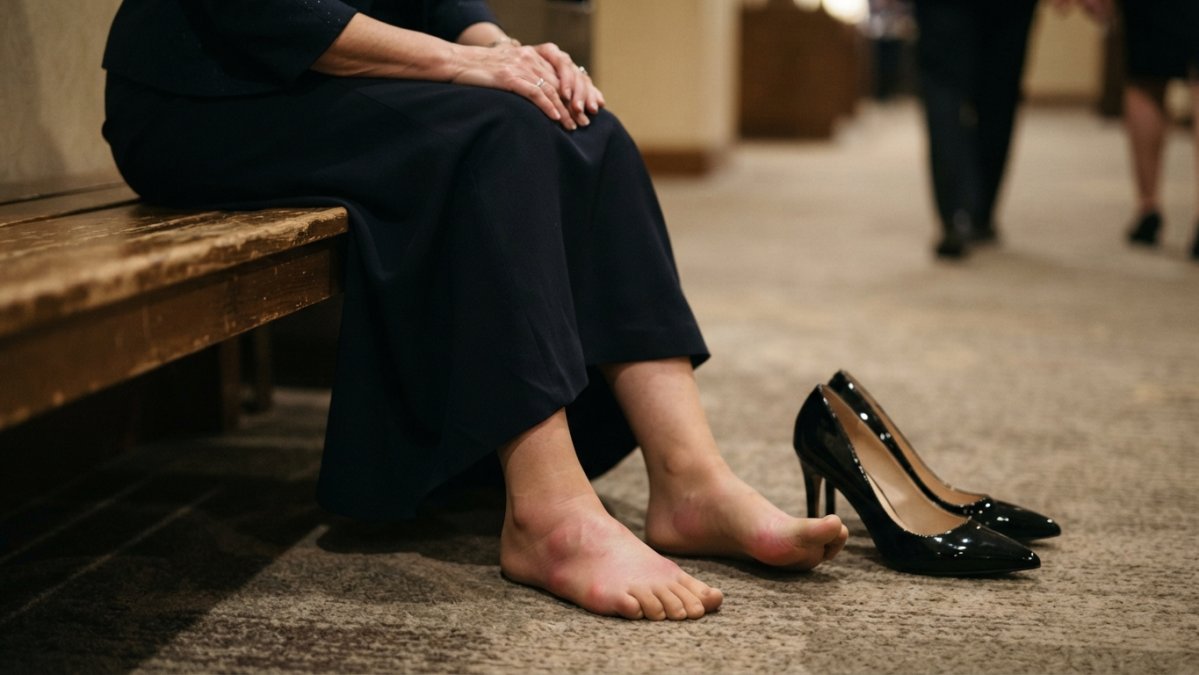
The clearest warnings are pain that lasts after you take the shoes off, redness that does not fade, and numbness or tingling in your toes. If any of these show up regularly, your feet are telling you something.
Here are signs to watch:
Short-Term Symptoms vs. Lasting Structural Changes
The takeaway: treat short-term symptoms as a warning, not a nuisance.
Common High Heel Foot Problems: From Bunions to Ankle Instability
Bunions form when the big toe pushes against the other toes inside a pointed-toe shoe. The joint at the base of the big toe shifts outward. The American Orthopaedic Foot & Ankle Society explains that narrow toe boxes and frequent heel wear both raise the risk.
Toe Numbness After Wearing Heels: What It Means and What to Do
What to do:
- Take the shoes off as soon as you can and wiggle your toes
- Choose a wider toe-box shape for your next pair
- Cut wear time on the tightest, highest pairs
- See a podiatrist if numbness persists or spreads
How to Relieve Foot Pain From High Heels
Start with these steps:
-
Alternate heel heights through the week so no single pair takes all the load
-
Switch to flats for commutes and long stretches of standing
-
Use a comfort spray before you put the shoes on, not after the pain starts
Here is where Still Standing® Spray fits in. Our foot comfort spray uses a cooling menthol formula made without numbing agents. Still Standing® is designed to support comfort while allowing you to maintain natural sensation while wearing heels. If you want more relief strategies, our guide on arch support for high heels walks through inserts and support options, and our piece on stretches for calf pain after wearing heels covers the tightness that builds up after long wear.

Best High Heel Inserts for Ball of Foot Pain: What to Look For
The best inserts for ball of foot pain spread pressure across a wider area and cushion the forefoot. Look for three things: metatarsal support, a slim profile, and material that does not slide.
What to check before you buy:
| Feature | What to Look For | Why It Matters |
|---|---|---|
| Metatarsal pad | Sits just behind the ball of the foot | Lifts and spreads forefoot pressure |
| Thickness | Thin enough to fit without squeezing toes | A thick insert crowds the toe box |
| Material | Gel, foam, or leather-backed | Grips the shoe and resists sliding |
| Coverage | Full forefoot, not just a strip | Spreads load across a wider area |
| Fit | Trim-to-size or heel-specific | Poor fit causes new pressure points |
A common mistake is buying a thick gel insert for a tight pair of heels. It fills the toe box and makes toe compression worse. Match the insert to the shoe, not the other way around.
When to Stop Wearing Heels and When to See a Doctor
If you are rethinking your go-to pair, our guide on the best heel height for all-day comfort explains how to choose a height your feet can handle for longer stretches. Lower, wider heels reduce forefoot pressure and lower your fall risk.
Build a Heel-Wearing Routine That Protects Your Feet
A good routine lowers the total load on your feet across the week. Build it around three habits: rotate, recover, and support.
-
Rotate: Alternate heel heights and mix in flats on heavy standing days
-
Support: Add inserts where they help, and use a comfort spray before wear
If you want a starting point for the strength side, our guide on exercises to strengthen feet for high heels lays out simple moves you can do at home.
For the support side, Still Standing® Spray comes in a full-size bottle, a travel-size mini, and a duo set. The spray is TSA-friendly, so it fits in a purse or carry-on.
Frequently Asked Questions
How can you tell if high heels are damaging your feet?
Watch for pain that lingers after you take your shoes off, redness or calluses on the ball of the foot, a big toe that angles toward the others, toes that curl or stay bent, numbness or tingling, and ankles that roll easily. Short-term soreness fades within a day. Symptoms that persist for days or worsen over weeks are the clearest signal that your high heels are damaging your feet and that it is time to change your footwear habits or see a podiatrist.
Can high heels cause bunions or hammertoes?
Yes. Pointed-toe shoes with a narrow toe box crowd the toes and push the big toe out of line, which encourages bunions over time. The same toe compression forces the smaller toes to bend at the joint, leading to hammertoes. Heel height adds to the problem by driving body weight onto the forefoot. Switching to wider toe boxes and lower heels, and limiting wear duration, reduces the pressure that drives these deformities.
How do you get feeling back in your toes after wearing heels?
Toe numbness after wearing heels usually comes from nerve compression or restricted circulation. Take the shoes off as soon as you can, wiggle and spread your toes, and massage from the toes toward the ankle to encourage blood flow. A cool compress can calm swelling. If feeling does not return within a few hours, or numbness keeps coming back after every wear, see a doctor to rule out lasting nerve irritation.
How can you wear high heels with less foot pain?
Choose a lower heel with a wider toe box, limit wear duration, and alternate heels with flats during long days. Still Standing® Foot Comfort Spray is a non-numbing, cooling menthol formula designed to help keep your feet feeling comfortable and refreshed while wearing high heels.
Your feet send signals long before damage sets in. The trick is catching the early ones: lingering forefoot pain, numb toes, a wobbling ankle. Still Standing® Spray gives you a non-numbing, cooling menthol formula that helps you stay comfortable in your heels without losing the sensation that keeps you steady. It is paraben-free, cruelty-free, and comes in a portable, TSA-friendly size. Get started with Still Standing® Spray and wear the shoes you love with more comfort and confidence.
